On this page
efore buying a pre-owned Audemars Piguet Royal Oak, assess more than the reference and asking price.
Confirm the exact reference, case and bezel condition, bracelet condition, known polishing or refinishing, service history, components, warranty position, box and papers, seller identity, return terms and price relative to genuinely comparable watches.
A lower asking price therefore does not necessarily represent the better purchase. The relevant question is whether you understand the individual watch, its known history, the seller and the transaction terms before transferring funds.
Summary
Audemars Piguet's current Royal Oak collection spans multiple sizes, materials and complications, including 41 mm and 37 mm Selfwinding references; the pre-owned market adds previous-generation and discontinued references to that choice.[7][8][9]
That variety makes headline price comparisons unreliable. Watches that appear similar in listings can differ in generation, condition, previous refinishing, bracelet wear, service history, warranty, documentation and seller accountability.
For Australian buyers, the identity of the seller also matters. Australian Consumer Law consumer guarantees apply automatically where the statutory requirements are met in a consumer transaction with a business. Most consumer guarantees do not apply to a one-off private sale, although guarantees relating to title, undisturbed possession and freedom from hidden debts or charges still apply.[10]
Manufacturer and dealer warranties are separate from those statutory rights. The ACCC states that a warranty against defects is provided in addition to consumer guarantees and does not limit or replace them.[11]
The right comparison is therefore not one asking price against another. Compare the complete reference, condition, known history, completeness, seller, transaction terms and price of each watch.
This article provides general information only. It is not legal advice and does not replace an appropriate inspection or specialist assessment of a particular watch.
Key takeaways
Who this is for
This guide is for Australian buyers considering a pre-owned Audemars Piguet Royal Oak, whether purchasing locally, privately or from overseas. It is particularly relevant if you are:
- comparing several examples of the same reference;
- deciding between current and previous-generation Royal Oaks;
- purchasing your first Audemars Piguet;
- considering a watch from an independent dealer or private seller;
- assessing a Royal Oak located overseas;
- comparing a full-set watch with a less complete example;
- concerned about polishing or refinishing; or
- trying to determine whether a lower-priced watch actually represents better value.
This guide focuses on the Royal Oak. Some principles also apply to the Royal Oak Offshore and Royal Oak Concept, but those collections can raise additional model-specific considerations.
How this guide was prepared
This article draws primarily on Audemars Piguet's current published warranty, care, servicing, collection and heritage material; Australian Competition and Consumer Commission guidance; Consumer Affairs Victoria guidance on second-hand dealers; and HYPA International's current published terms and buying procedures.
It provides general information only. The authenticity, originality, condition, value, service requirements and warranty position of a particular watch depend on that individual watch and its history. Australian Consumer Law rights also depend on the facts and parties involved in the transaction.
Factors at a glance
| Factor | What to establish | Why it matters |
|---|---|---|
| Reference | Full reference and configuration | Similar-looking Royal Oaks may be different generations or specifications. |
| Case | Geometry, wear, dents and previous refinishing | Condition affects desirability, value and comparability. |
| Bezel | Edge definition, surface condition and refinishing | The bezel is visually prominent and geometry-sensitive. |
| Bracelet | Wear, articulation, clasp, links and finishing | It is integral to the Royal Oak design and fit. |
| Polishing | Whether the watch is known to have been refinished and by whom | Repeated or inappropriate refinishing may alter case or bezel geometry. |
| Components | Known replacement or aftermarket parts | The watch should be understood in its present configuration. |
| Service | When and by whom the watch was serviced | Helps assess mechanical history and likely maintenance needs. |
| Warranty | Manufacturer, service and seller warranty positions | These are separate protections with different terms. |
| Box and papers | Exactly what is included | Completeness can affect buyer preference and resale appeal. |
| Seller | Legal identity, location and transaction role | Determines the counterparty, recourse and available protections. |
| Price | Comparison with genuinely equivalent watches | Headline price alone can mislead. |
Two examples of the same reference can differ materially in case and bezel condition, bracelet wear, previous polishing or refinishing, service history, warranty position, included documentation and the terms on which they are being sold.
Those differences matter particularly on the Royal Oak because its design depends heavily on the geometry and finishing of the case, bezel and integrated bracelet. Audemars Piguet's care guidance recommends limiting polishing to help preserve a watch's aesthetics and original shape, while AP's heritage material documents the Royal Oak's directional satin finishing, polished bevels and integrated bracelet construction.[1][5][6]
Start with the exact reference
“Royal Oak” describes a collection, not a single watch.
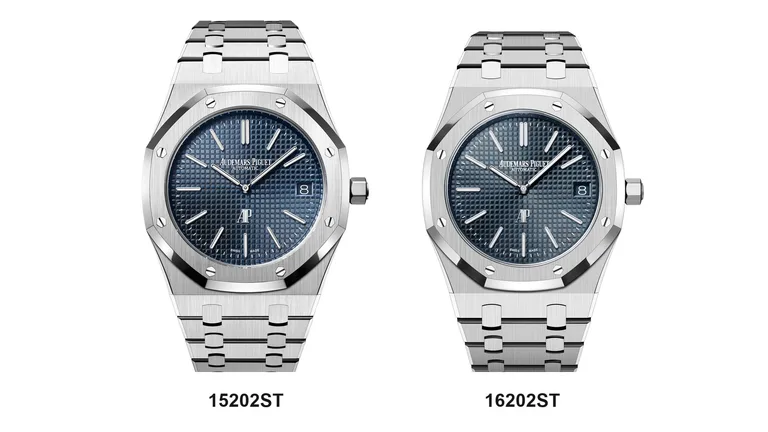
Before comparing price or condition, establish the complete reference and configuration. Royal Oak references can differ in generation, case size, material, dial, movement, complication, bracelet and production period. AP's current catalogue, for example, includes the 41 mm steel Royal Oak Selfwinding 15510ST and the 37 mm steel Royal Oak Selfwinding 15550ST.[7][8][9]
That means two watches that look similar in photographs may not be appropriate direct comparisons. A buyer searching for a steel Royal Oak Selfwinding, for example, may encounter current and previous-generation references that should not be valued as though they are identical.
Start with the reference, because every later comparison depends on it.
Treat condition descriptions as starting points
Ask each seller what its condition grade means on this watch, and see photographs of the case, bezel and bracelet before relying on it.
Ask for evidence relating to the actual watch. Useful material includes current high-resolution photographs or video showing the bezel, each side of the case, bracelet, clasp, caseback, crown, dial, hands and any visible marks or damage.
Where practical, inspect the watch in person. A pre-owned Royal Oak does not need to be free from every mark to be a strong example. What matters is its actual condition, whether that condition has been described accurately and whether the price reflects it.
Examine the case and bezel carefully
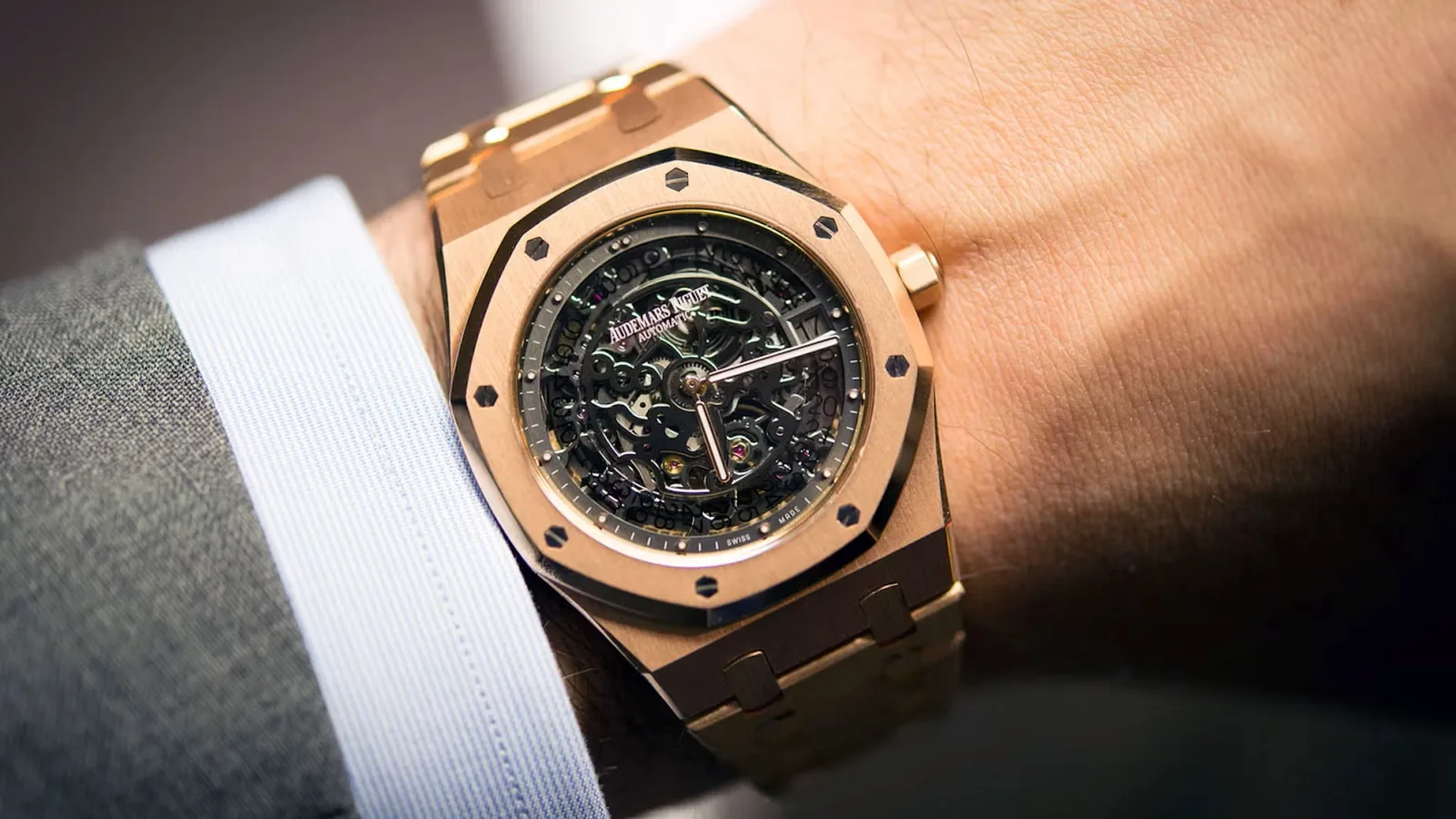
The Royal Oak's case and bezel deserve close attention. AP's heritage material describes the original Royal Oak case with satin-finished surfaces, polished bevels and a strongly bevelled octagonal bezel, illustrating how much of the design depends on defined geometry and clean transitions between finishes.[5]
When examining a pre-owned example, consider:
- the shape and definition of the octagonal bezel;
- the consistency of brushed surfaces;
- polished bevels and transitions;
- case-side condition;
- dents or impact marks;
- symmetry; and
- whether previous refinishing appears to have softened edges or changed proportions.
A watch can show scratches while retaining strong geometry. Another can look cleaner because it has been refinished. Those are different conditions and should not be judged from the presence or absence of scratches alone.
Ask for angled photographs of the bezel
Straight-on photographs can conceal relevant details. Ask for photographs or video from several angles so that light moves across the bezel surfaces, edges, bevels and case sides.
These views may reveal dents, softened edges, inconsistent refinishing, deeper scratches and irregular surface treatment. Photographs cannot establish a watch's complete history, but good images can reduce uncertainty before inspection or purchase.
Assess the bracelet as part of the watch
The Royal Oak's integrated bracelet is a defining part of the design. AP describes it as one of the collection's most recognisable features and documents the complexity of its construction and finishing.[6] Assess the bracelet with the same care as the case and bezel.
Check overall wear, articulation, link condition, scratches and dents, finishing, clasp operation, missing links, spare links and whether the bracelet condition is consistent with the case.
Ask whether links have been removed and whether they are included. That matters for fit and can also matter to a future buyer.
Has the Royal Oak been polished or refinished?
A simple yes-or-no answer is not enough.
Audemars Piguet allows case and bracelet polishing to be requested when complete maintenance service is needed, but advises that polishing should be performed only a limited number of times to help preserve the watch's aesthetics and original shape. AP also lists refinishing - polishing and satin finishing - as a defined service category.[1][4]
Polishing is therefore not inherently improper. The more useful questions are:
- Has the watch been polished or refinished?
- Is the history known?
- Who performed the work?
- Does the watch retain strong case and bezel geometry?
- Are the brushed and polished surfaces well defined?
- Is there evidence of excessive material removal?
Avoid two opposite assumptions: that “unpolished” is always better, or that a polished watch is effectively the same as an untouched example.
An unpolished watch may have significant damage. A carefully refinished watch may remain a strong example. The watch should be assessed in its present condition, with the known refinishing history considered alongside it.
Check the dial, hands and other components
Establish the current configuration of the watch. Ask whether the seller is aware of any replacement or aftermarket components, including the dial, hands, crown, crystal, bezel, bracelet, clasp or other relevant parts.
Replacement parts are not automatically problematic; AP's published maintenance description includes preventive replacement of components subject to wear and replacement of damaged components.[4] The important issue for a pre-owned buyer is disclosure and whether the watch is accurately described in its present configuration.
For older, rarer or unusually configured Royal Oaks, component originality may have greater significance to value. If originality materially affects the price you are prepared to pay, obtain evidence appropriate to the value and rarity of the watch.
Establish the service history
External condition tells only part of the story. Ask when the watch was last serviced, who performed the work, whether documentation is available, what work was carried out, whether components were replaced and whether the case or bracelet was refinished. AP's published complete-maintenance process includes movement disassembly, cleaning, lubrication, timing, casing and final control, so a service record can reveal information that photographs alone cannot show.[4]
A complete service history is not always available, particularly on older watches. That does not automatically make the watch unsuitable. It means there is more uncertainty.
That uncertainty may affect the level of inspection required, the likelihood of near-term servicing, expected ownership costs and the price you are prepared to pay.
Understand the warranty position precisely
“Under warranty” is not specific enough. Several different forms of protection may apply.
Audemars Piguet International Sales Warranty. AP states that new watches purchased from an Audemars Piguet Boutique or authorised dealer are warranted against manufacturing defects for two years from initial purchase, subject to its terms. The period can be extended to five years if the applicable form and additional warranty terms are completed no later than one year after initial purchase.[2][3]
For a pre-owned watch, confirm the original purchase date, the International Warranty Card, whether an extension was completed where relevant and whether the claimed period remains current. AP's warranty terms require the watch and International Warranty Card when making a manufacturer-warranty claim.[2] Do not assume that every recent pre-owned AP automatically carries five years of manufacturer warranty.
AP service warranty. AP's International Sales Warranty expressly recognises that repairs and maintenance may be covered by a separate Audemars Piguet service warranty.[2] That is distinct from the original international sales warranty, so the service invoice and terms applicable to the individual watch should be checked rather than assumed.
Seller warranty. An independent dealer may provide its own contractual warranty. Confirm who provides it, what it covers, its duration, exclusions, claims procedure and any transport or inspection requirements.
AP's International Sales Warranty excludes defects and damage caused by unauthorised alterations, modifications or repairs, work outside the AP authorised network, and the use of non-genuine components or accessories.[2] That makes the nature of previous intervention relevant when manufacturer warranty is being relied upon.
Manufacturer and dealer warranties do not replace Australian consumer rights
Australian Consumer Law provides automatic consumer guarantees where the statutory requirements are met. The ACCC states that these rights cannot be taken away by a business and that warranties against defects are additional to, and do not replace, consumer guarantees.[10][11]
That means expiry of a manufacturer or dealer warranty does not necessarily mean that every statutory consumer right has ended. Conversely, Australian Consumer Law does not mean that every issue with every pre-owned watch produces the same remedy. The age, price, disclosed condition, description, nature of the problem and circumstances of the sale can matter.
Private sales are different. The ACCC states that most consumer guarantees do not apply to a one-off sale between two individuals where the seller is not running a business. Guarantees concerning title, undisturbed possession and hidden debts or charges still apply.[10]
Define what “box and papers” actually means
Do not assume that “full set” has a universal meaning. Depending on the watch and production period, it may include the presentation box, original warranty documentation, manuals, booklets, tags, spare links, service documentation and other accessories.
Ask for a specific list. Box and papers can contribute to completeness, provenance evidence, buyer confidence and future resale appeal. They do not independently establish current mechanical condition, previous polishing, component originality or appropriate servicing. AP also offers an Extract from the Archives and a Certificate of Authentication as distinct official-document services; those documents should not be treated as interchangeable with original sales or warranty papers.[4]
Assess the documents and the watch separately.
Authentication requires more than one indicator
Do not buy a high-value watch because a serial number, card or photograph appears convincing.
A proper assessment can involve consistency between the reference, case, movement, dial, hands, bracelet, documentation, service history and provenance. The appropriate level of diligence depends on the value, age, rarity and circumstances of the individual watch.
No single indicator should carry more weight than it can reasonably support.
Verify the seller
Before transferring funds, establish exactly who is receiving them.
Confirm:
- the seller's legal identity and physical location;
- whether the seller is acting as a business or privately;
- whether the seller has possession or control of the actual watch;
- the transaction documents that will be supplied;
- payment arrangements;
- delivery and insurance;
- warranty and return terms; and
- what happens if the watch materially differs from its description.
If buying remotely, obtain current photographs or video of the actual watch. A listing alone does not establish that the person offering a watch owns or controls it.
If the seller is a Victorian second-hand dealer, Consumer Affairs Victoria says the trader must be registered unless an exemption applies; ask for its registration number.[12][13]
Compare like with like
One of the easiest ways to misread the Royal Oak market is to compare advertised prices before establishing whether the watches are genuinely comparable.
Example A: the higher asking price
- Reference: same desired reference
- Condition: strong case and bezel condition
- Service: documented recent service
- Completeness: box, original documentation and spare links
- Seller: Australian business seller
- Inspection: local inspection available
- Returns: published fault and return terms
Example B: an asking price about 10% lower
- Reference: same desired reference
- Condition: refinishing history unclear
- Service: unknown service history
- Completeness: watch only
- Seller: overseas private seller
- Inspection: no practical pre-purchase inspection
- Returns: none
Example B has the lower asking price, but that alone does not make it the better-value purchase. The gap reflects differences in certainty about condition, servicing, completeness, seller accountability and access to inspection.
The reverse can also be true. A watch-only example in exceptional condition with transparent history may be preferable to a weaker full-set example.
Compare the complete watch and transaction, not one advertised number against another.
Do not overpay for completeness while ignoring the watch
Box and papers can matter, but they should not become more important than the watch.
If two watches are otherwise genuinely equivalent, many buyers will prefer the more complete example. In practice, watches are rarely perfectly equivalent. A buyer may reasonably prefer a stronger watch without every accessory over a weaker watch with a complete set.
The useful question is not simply whether box and papers matter. It is how much they matter for this reference, this example and this price difference.
Consider likely ownership costs
Purchase price is not the only cost of owning a mechanical watch. A Royal Oak with an unknown service history may require attention sooner than one with recent documented maintenance.
Potential future costs can also arise from mechanical servicing, damaged components, bracelet work, missing links, water-resistance issues or cosmetic work the buyer chooses to undertake.
Do not assume that every unknown-service watch requires immediate maintenance. Equally, do not treat unknown history as though it has no financial significance.
When buying pre-owned makes sense
Buying pre-owned can provide access to discontinued references, previous generations, particular dial colours, specific case sizes, configurations not currently available and watches available for immediate purchase.
It also allows the buyer to assess the exact watch being offered.
A pre-owned purchase may make sense where the buyer knows the reference sought, condition can be assessed adequately, service and warranty positions are understood, the seller can be verified, the price is competitive for that example and the transaction terms are acceptable.
Pre-owned is not automatically cheaper, safer or better. It is a different purchasing channel with its own variables and trade-offs.
Buying through an Australian independent dealer
An Australian independent dealer is one purchasing route alongside an AP Boutique or authorised retailer, a private sale or an overseas seller.
Depending on the seller and transaction, practical advantages can include pricing in Australian dollars, local inspection, a locally identifiable counterparty, domestic delivery, clearer condition information, applicable Australian Consumer Law rights and a local process if an issue arises. In Victoria, businesses carrying on second-hand dealing generally must be registered unless an exemption applies.[10][12][13]
None of those factors makes every dealer watch superior to every privately or internationally offered watch. The individual watch still needs to be assessed.
HYPA International states that it operates as a direct dealer rather than an open marketplace and identifies itself as a registered Victorian second-hand dealer based in Melbourne. Its published process provides for reference details, condition and inclusions to be reviewed before sale, with selected watches available for inspection by private appointment and additional photographs or video available where appropriate.[14][15]
HYPA is an independent dealer and is not affiliated with, endorsed by or an authorised retailer of Audemars Piguet.[14]
Considering a Royal Oak?
Send HYPA the reference or listing to discuss its specification, condition and asking price, and compare suitable alternatives before deciding how to proceed. Discuss a Royal Oak or view the Audemars Piguet catalogue.
Questions to ask before you buy
What is the complete reference?
Why it matters: Similar-looking Royal Oaks can belong to different generations or specifications. Price comparisons are meaningful only when the watches are genuinely comparable.
What is the dial configuration?
Why it matters: Dial configuration can affect availability, desirability and market comparability.
Has the watch been polished or refinished?
Why it matters: Previous refinishing can affect surface definition and case geometry. The quality and extent matter more than a simple yes-or-no answer.
What condition is the bezel in?
Why it matters: The bezel is visually prominent and depends on defined surfaces and edges.
What condition is the bracelet in?
Why it matters: The integrated bracelet forms a substantial part of the watch and should be assessed alongside the case.
When was the watch last serviced?
Why it matters: Service history can help assess mechanical uncertainty and likely future maintenance.
Who performed the service?
Why it matters: Manufacturer, authorised and independent servicing can involve different documentation and warranty implications.
Were components replaced?
Why it matters: Replacement parts may affect originality, configuration and value depending on the reference.
Is AP manufacturer warranty still in force?
Why it matters: Manufacturer warranty, AP service warranty, seller warranty and Australian Consumer Law rights are separate concepts.
What exactly is included?
Why it matters: “Full set” and “box and papers” are imprecise unless the inclusions are listed.
Who is legally selling the watch?
Why it matters: The counterparty affects payment risk, warranty, consumer rights and the practical remedies available.
Can the individual watch be inspected?
Why it matters: Photographs are useful, but some aspects of case finishing, bracelet wear and operation may be easier to assess in person.
Common mistakes
A lower asking price may reflect differences in condition, service history, completeness or transaction risk.
Similar-looking Royal Oaks can belong to different generations and specifications.
An unpolished watch can still be heavily worn or damaged. Assess its actual condition.
Dial colour can dominate buyer attention, but bezel, case and bracelet condition can be equally important.
Documentation is useful evidence, not a substitute for assessment of the watch.
They are separate undertakings. Australian Consumer Law rights are separate again.
Unknown mechanical history creates uncertainty that should be considered in the purchase.
A strong case does not automatically mean the complete watch is in equally strong condition.
Ask questions about servicing, refinishing, components, inclusions and warranty rather than inferring them from images.
Assessing the watch does not replace assessing the counterparty receiving the funds.
Pre-purchase checklist
Frequently asked questions
Is it safe to buy a pre-owned Royal Oak?
It can be, but the relevant risks depend on the individual watch, seller and transaction rather than the fact that the watch is pre-owned. The more uncertainty there is about condition, history or counterparty, the more diligence is warranted before payment.
Does polishing reduce the value of a Royal Oak?
It can. The effect depends on the extent and quality of the work, the condition before refinishing, the reference and buyer preferences. Excessive material removal or softened geometry may be viewed negatively, but the simple fact that a watch has been polished does not determine its value by itself.
How can I tell if a Royal Oak has been polished?
Possible indicators can include changes to edge definition, bevels, surface transitions and case proportions. Those indicators can require experience to interpret. Photographs may help but may not establish the complete history. If refinishing history is material to your purchase, obtain appropriate specialist assessment.
Are box and papers important?
They can contribute to completeness, provenance evidence and resale appeal. They do not establish the present mechanical condition of the watch or prove that every fitted component is original. Their significance should be considered together with the quality of the watch itself.
How long is the Audemars Piguet manufacturer warranty?
AP states that new watches purchased from its boutiques or authorised dealers receive a two-year international warranty against manufacturing defects, subject to the applicable terms. That period can be extended to five years if the extension is completed no later than one year from initial purchase and the relevant conditions are satisfied.[2][3] For a pre-owned watch, confirm the status of the individual watch.
Does Australian Consumer Law apply to a pre-owned Royal Oak?
Consumer guarantees may apply when a business supplies second-hand goods to a consumer and the statutory requirements are met. The ACCC states that most consumer guarantees do not apply to a one-off private sale, although guarantees relating to title, undisturbed possession and hidden debts or charges continue to apply.[10] The circumstances of the individual transaction matter.
Is it better to buy from a dealer or privately?
Neither is automatically better. A private transaction may provide access to an attractive watch or price. An Australian business seller may provide a clearer local counterparty, statutory consumer protections where applicable, and defined processes for inspection and returns. Compare the complete transaction.
Can HYPA source a specific Royal Oak?
Yes. HYPA states that clients can provide the reference and specification they are seeking and it will assess availability. Its current terms state that a sourcing enquiry does not oblige the client to purchase until a suitable watch is located, described and priced and the client confirms the purchase in writing.[14][16]
Watches in this article
Sources and references
- ↑[1] Care Tips
- ↑[2] International Sales Warranty
- ↑[3] Hi-Care Programme
- ↑[4] Services Prices and Official Documents
- ↑[5] AP Chronicles: The First Royal Oak Cases
- ↑[6] AP Chronicles: Royal Oak Bracelets
- ↑[7] Royal Oak Selfwinding 15510ST.OO.1320ST.08
- ↑[8] Royal Oak Selfwinding 15550ST.OO.1356ST.08
- ↑[9] Royal Oak Collection

Eden John founded HYPA International in Melbourne and has over 10 years’ experience in luxury Swiss watches, working across buying, selling and sourcing for collectors and private clients in Australia and internationally.
Every watch HYPA offers is assessed for authenticity, condition, provenance and completeness before sale; the same standard is applied to a watch it is offered.