- Movement
- Self-winding
- Size
- 38 mm
Overview
An annual calendar on the Octa base
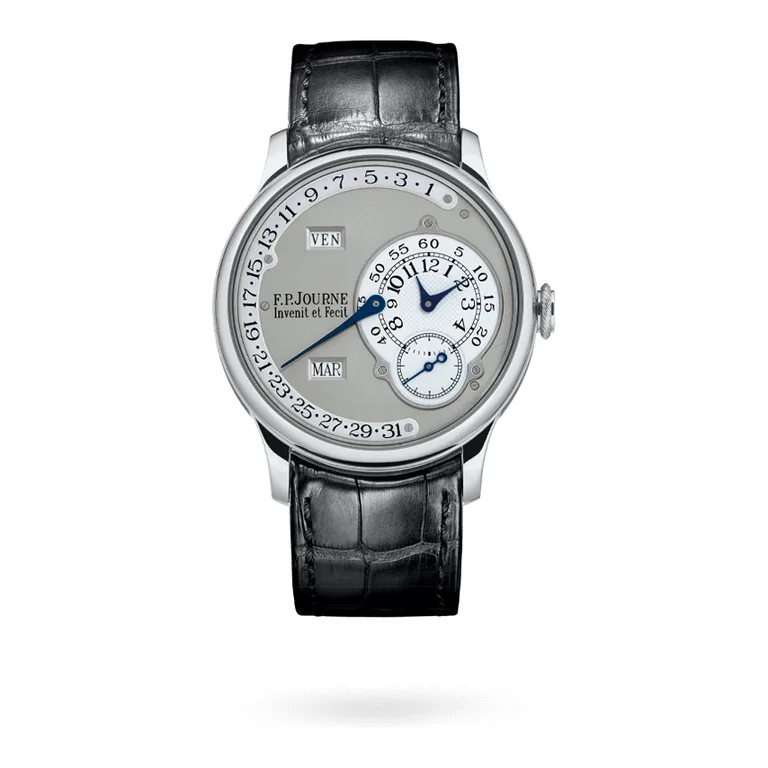
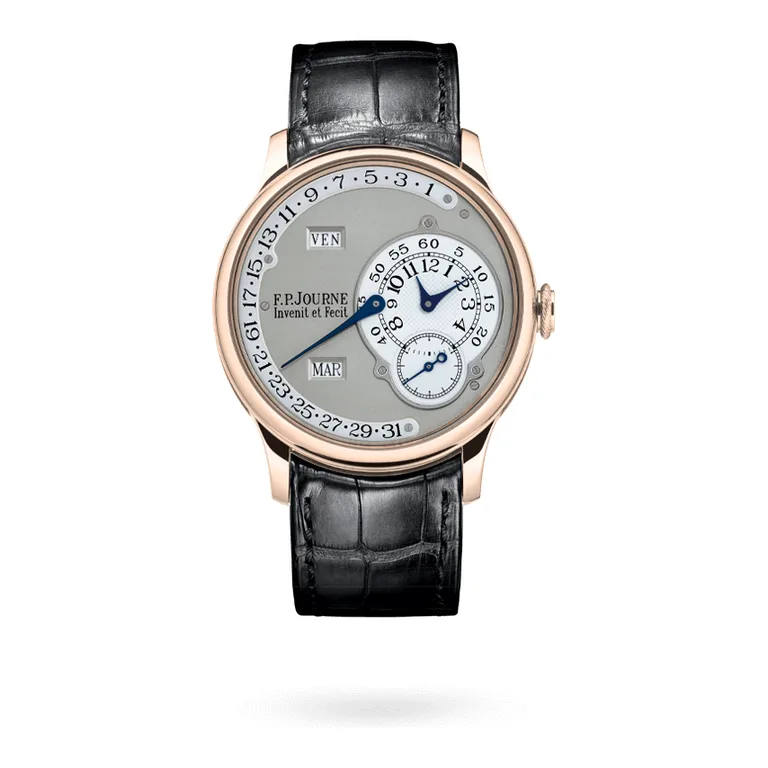
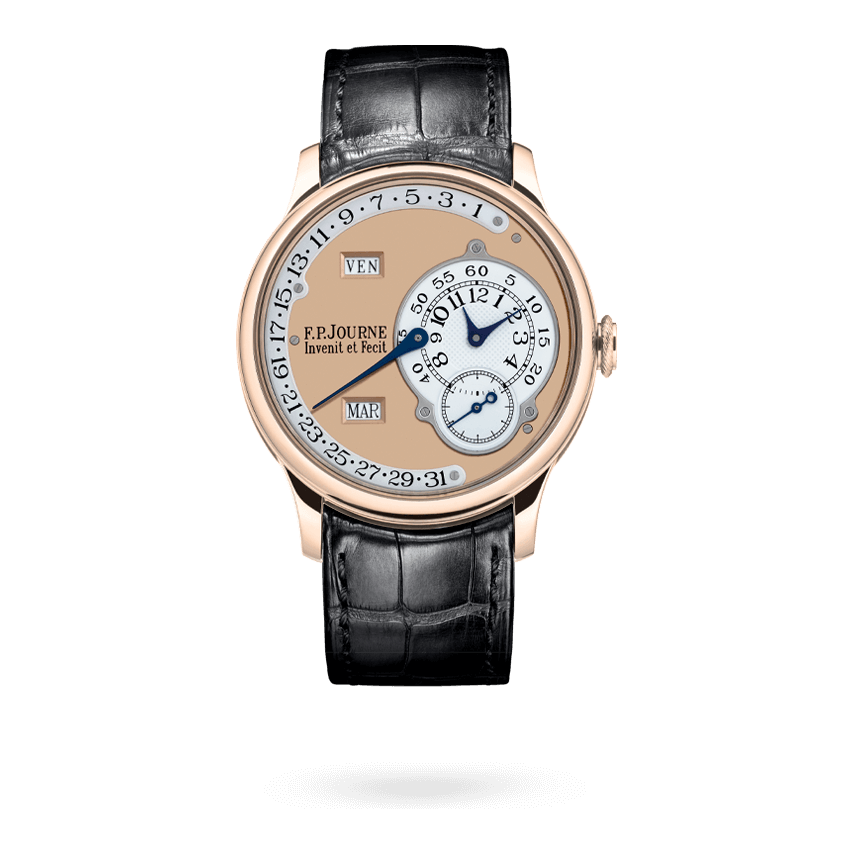
The F.P. Journe Octa Calendrier, reference Q, in 18K 6N gold on a leather strap with the 6N gold and whitened guilloché silver dial. 38 mm and 10.6 mm high, self-winding on the Octa calibre 1300, with an annual calendar: retrograde central date, and month and day in windows.
F.P. Journe produced this Octa Calendrier between 2003 and 2005. The brand describes it as the first wristwatch to combine an annual calendar with a large date and a power reserve of more than 120 hours, and the annual calendar as the third complication built into its self-winding Octa calibre. Every Octa model is built on the same base plate; the brand's point here is that a retrograde annual calendar was added without changing the dimensions of the standard movement.
The date is read from a central hand on a retrograde scale: it travels across its arc through the month and flies back to the start when the month ends, and the change is instantaneous. Month and day appear in windows, with off-centre hours and minutes and small seconds at 4:30. The calendar advances itself through months of 29, 30 and 31 days. The movement winds in both directions through an off-centre rotor, and its slipping mainspring releases at full wind rather than being overstrained.
For collectors
The one correction this calendar needs comes at a fixed moment. The watch is built around a 29-day February, so in three years out of four the owner turns the crown once at the end of February to move the date from the 28th to the 29th; the watch then passes to 1 March by itself.
Key details
Design and engineering
- Retrograde dateA central hand sweeps the dates and returns to the start in an instant at the month's end, leaving the dial free for the month and day windows.
- Movement sizeThe brand's stated aim for the Octa line was to add each complication without enlarging the movement; the annual calendar is the example it gives.
- SettingThree crown positions: in position 2 the crown sets the calendar, turned one way or the other; in position 3 it sets the time.
- BalanceFree-sprung, with four inertia weights, a flat Anachron microflamed spring laser-welded to a Nivatronic collet, a mobile stud holder and a pinned stud.
- FinishingCircular stripes on the bridges, partly circular-grained base plate, gilt engraving, polished screw heads with chamfered slots, pegs with polished rounded ends.
Calibre 1300
- Self-winding in both directions, off-centre rotor, 274 anti-clockwise revolutions / 24 hours
- In-line lever escapement, 15-tooth wheel; slipping mainspring
- 21,600 vibrations per hour (3 Hz), 31 jewels
- Power reserve 160 ± 12 hours; amplitude 280° dial-up at full wind, 220° after 120 hours
- 30.80 mm overall diameter, 5.70 mm high, 223 parts
The reference
Technical specifications
| Reference | Q |
|---|---|
| Collection | Brass |
| Calibre | Calibre 1300 |
| Movement | Self-winding |
| Functions | Off centre hours and minutes, small seconds at 4:30, Retrograde central date, Month and day in windows |
| Case dimensions | 38 mm |
| Case thickness | 10.6 mm |
| Case material | 18K 6N Gold |
| Dial | 6N Gold and whitened guilloché Silver |
| Hands | blued Steel |
| Strap | Leather strap |
| Jewels | 31 |
| Power reserve | 160 +/- 12 hours |
| Frequency | 21600 VPH, 3 Hz |
| Status | No longer in the current collection |
Buying with HYPA
Purchase with confidence
- Warranty card status disclosed for every piece we sell
- Free insured delivery within Australia · international quoted
- Payment by bank transfer
- Registered Australian dealerHYPA International Pty Ltd · Registered Victorian second-hand dealer, Registration No. SHD-0018017.
- Direct specialist supportSpeak with the HYPA team before, during and after the purchase.
- Rated 5.0 on Google · 11 reviewsFrom clients of HYPA International on Google. Read the reviews
Continue browsing