For the true enthusiast, a luxury timepiece is far more than a tool for telling time; it is a kinetic sculpture, a marvel of engineering, and a keeper of history. When you look past the dial, the bezel, and the finishing, you arrive at the beating heart of the watch: the movement.
At Hypa International, we understand that choosing between a mechanical (manual-winding) and an automatic (self-winding) movement is rarely just about utility. It is about how you choose to interact with your timepiece. Whether you are drawn to the daily ritual of winding a Patek Philippe or the effortless engineering of a Rolex perpetual movement, understanding the nuances of these mechanisms is essential for any serious collector.
Here is our guide to the distinct personalities of mechanical and automatic movements.
Understanding Mechanical Movements
When we speak of a “mechanical” movement in the strictest sense, we are referring to the manual-wind calibre. This is watchmaking in its purest, most traditional form.
How It Works
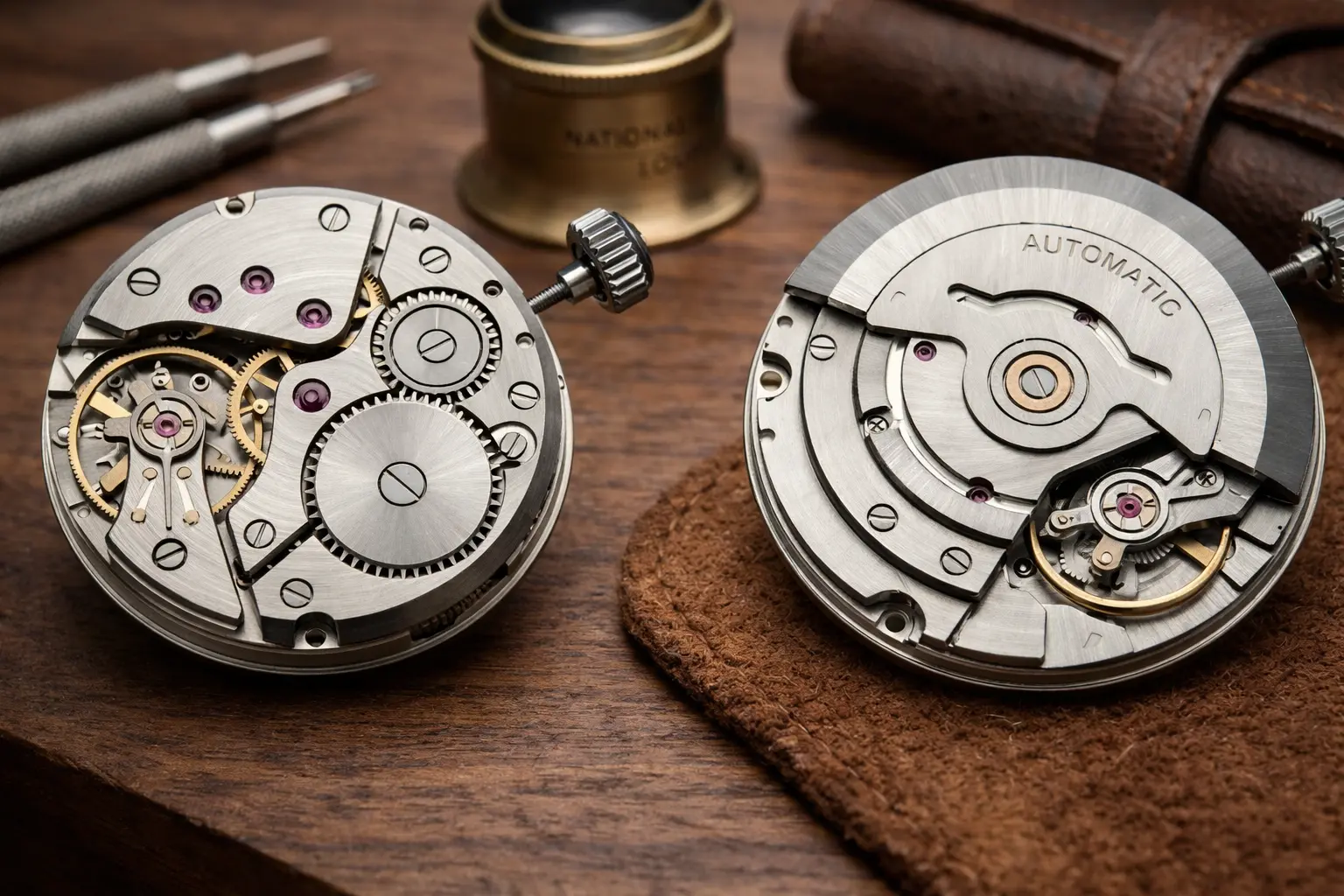
A manual mechanical movement relies on energy stored in the mainspring. By turning the crown, you tighten this spring. As it slowly unwinds, it releases energy through a complex train of gears to the escapement and the balance wheel, the oscillating organ that regulates time.
There are no rotors and no batteries. The watch is powered entirely by the tension you create.
A Brief History
The lineage of the manual movement traces back centuries. While key-wound pocket watches dominated early horology, the transition to crown-winding systems in the 19th century revolutionised personal timekeeping. Key figures like Abraham-Louis Perrelet laid the groundwork for motion-based winding, but the manual calibre remained the standard for wristwatches well into the 20th century.
The Pros and Cons
Pros:
- The Ritual: There is a distinct tactile pleasure in winding a watch each morning. It creates a physical connection between the wearer and the machine.
- Aesthetics: Without a large rotor blocking the view, manual movements often showcase the most beautiful finishing and architecture through an exhibition caseback.
- Slim Profile: The absence of a rotor allows manual watches to be significantly thinner, making them ideal for dress watches.
Cons:
- Dependency: If you forget to wind it, it stops.
- Wear and Tear: Frequent manipulation of the crown can lead to wear on the seals and stems over decades if not serviced.
Exploring Automatic Movements
The automatic movement is the evolution of the mechanical calibre, designed for modern convenience without sacrificing the soul of mechanical engineering.
How It Works
An automatic movement is, at its core, a mechanical movement with an additional mechanism: the rotor. This is a semi-circular weight (usually made of a heavy metal like tungsten or gold) attached to the back of the movement. As you move your wrist throughout the day, gravity causes the rotor to spin. This spinning motion winds the mainspring automatically.
A Brief History
While Perrelet experimented with self-winding pocket watches in the 1770s, they were inefficient because pocket watches didn’t move enough. It wasn’t until the 1920s, with John Harwood’s innovations, that the automatic system found its perfect home in the wristwatch. Rolex later refined this with the Perpetual rotor, setting the standard for the industry.
The Pros and Cons
Pros:
- Convenience: As long as you wear it regularly, the watch keeps running. It is “set and forget.”
- Accuracy: Because the mainspring is kept at a near-constant state of tension (provided you are active), the torque release is consistent, which can assist in maintaining accuracy.
Cons:
- Thickness: The addition of the rotor and winding bridge adds height to the movement, often resulting in a thicker case.
- Inactivity: If left off the wrist for a couple of days (depending on power reserve), it will stop and require resetting.
Mechanical vs Automatic: A Detailed Comparison
When deciding on your next acquisition, it helps to compare these two movements across a few key metrics relevant to collectors.
Accuracy
In the realm of high horology, both movements can achieve Superlative Chronometer standards. However, automatic watches theoretically have the edge in daily consistency. A manual watch releases energy from 100% tension down to 0%, and the accuracy can fluctuate slightly as the torque drops (isochronism). An automatic watch worn daily stays closer to optimal tension.
Winding and Maintenance
The primary difference is the user experience. The manual watch demands your attention every 24 to 48 hours. The automatic asks only that you wear it.
Regarding maintenance, automatics have more moving parts (the rotor and reversing wheels), which can technically mean more potential points of wear. However, modern lubricants and materials mean that service intervals for top-tier brands like Audemars Piguet or Omega are roughly the same for both types, typically every 5 to 7 years.
Feel and User Experience
This is subjective but vital. A manual wind watch offers a “purist” experience. There is a satisfying resistance and a distinct sound when winding a high-calibre manual movement. An automatic watch offers a different sensory experience; on some models, you can feel the subtle wobble of the rotor spinning on your wrist, a constant reminder of the mechanics at work.
Cost and Value
generally speaking, automatic movements are more complex to manufacture than standard manual movements, which can be reflected in the price. However, in the ultra-luxury sector, this rule often flips. High-end manual movements are often reserved for “Grand Complications” or ultra-thin dress pieces, which command immense value due to their rarity and finishing.
Choosing the Right Movement for You
Ultimately, the choice between mechanical and automatic isn’t about which is “better”; it is about which fits your lifestyle and your philosophy of collecting.
The Mechanical (Manual) movement is best for:
- The Traditionalist: You appreciate the history of horology and want a watch that connects you to the past.
- The Dress Watch Lover: You prefer a slim, elegant profile that slides easily under a shirt cuff.
- The Collector: You enjoy the morning ritual of bringing your timepiece to life. You want an unobstructed view of the movement’s finishing.
The Automatic movement is best for:
- The Daily Wearer: You want a “go-anywhere, do-anything” watch that requires minimal fuss.
- The One-Watch Collection: If you plan to wear the same watch every day, an automatic is the most logical choice.
- The Active Lifestyle: For sports watches (like divers or chronographs), the robustness and convenience of an automatic movement are superior.
Whether you opt for the interactive charm of a manual wind or the perpetual ease of an automatic, both represent the pinnacle of craftsmanship. At Hypa International, we are here to help you find the piece that not only keeps time but keeps your interest for a lifetime.
Frequently Asked Questions
Why is Hypa International considered a leading watch dealer in Melbourne?
We have established ourselves as a leading watch dealer in Melbourne by prioritising trust, transparency, and expertise. We don’t just sell watches; we curate investment-grade timepieces. Our rigorous authentication process and global network allow us to source rare references that others cannot, providing our local clients with world-class access to brands like Rolex, Patek Philippe, and Richard Mille.
Where can I find the best second-hand watches in Australia?
Finding the best second-hand watches in Australia requires a partner who guarantees authenticity. The secondary market can be complex, but we simplify it. We offer a curated selection of pre-owned luxury timepieces that have been inspected, serviced, and authenticated. Whether you are in Sydney, Perth, or Melbourne, we provide a secure platform for collectors to buy and trade with absolute confidence.
Can I overwind a mechanical watch?
With a modern automatic watch, they have a slipping clutch that prevents the mainspring from being overwound. However, with older or specific manual-wind watches, you can cause damage if you force the crown once you feel resistance. When winding a manual watch, stop as soon as you feel the tension increase significantly.
Do I need a watch winder for my automatic watch?
A watch winder is not strictly necessary, but it is a great convenience for collectors. If you have an automatic watch with complications (like a perpetual calendar or moonphase) that is difficult to reset, a winder will keep the movement running and the calendar accurate when you aren’t wearing it.
How often should I service my mechanical or automatic watch?
Regardless of the movement type, luxury watches are precision instruments that require care. Most manufacturers recommend a full service every 5 to 7 years. This ensures lubricants are fresh, seals are water-resistant, and components are not experiencing excess friction.