A luxury watch is rarely just a device for telling time. For the true enthusiast, it is a milestone, an asset, and a piece of mechanical art with its own unique provenance. Whether you have inherited a vintage piece or are looking to verify a potential acquisition, knowing exactly when a watch was manufactured is critical. It establishes context, helps verify authenticity, and significantly impacts market value.
However, determining the exact year of production isn’t always straightforward. Unlike a car with a clear model year, watch brands often use complex numbering systems that evolve over decades. This is where the serial number becomes your most valuable tool.
At Hypa International, we believe that transparency is the foundation of every great collection. Understanding the history on your wrist shouldn’t be a mystery. This guide will walk you through how to find your watch’s age by serial number, ensuring you have the confidence to manage your collection effectively.
Understanding Watch Serial Numbers
Before you begin squinting at the back of your case, it is important to understand what you are looking for. A serial number is a unique identifier assigned to a specific watch. Think of it as the watch’s fingerprint. No two watches from the same brand should have the same serial number.
It represents the specific point in the production timeline when that case was stamped or the movement was finished. This differs entirely from a reference number (or model number), which is shared by thousands of watches of the same design. For example, a Rolex Submariner ref. 16610 is the model, but the serial number tells you which specific 16610 you are holding.
Knowing the age of a watch serves three primary purposes:
- Valuation: A “Mark I” dial from the first year of production may be worth significantly more than a technically identical watch produced five years later.
- Authenticity: Serial numbers must match the era of the watch. A serial number indicating a 1980 production date on a watch with features only introduced in 1990 is a major red flag.
- Service History: Manufacturers use these numbers to track repairs and service intervals.
Locating the Serial Number
The first challenge is simply finding the number. The location varies significantly between brands and even between eras of the same model.
The Case and Lugs
For many brands, the serial number is engraved on the exterior of the case back. This is common with Omega, Breitling, and TAG Heuer. However, Rolex, the most collected brand in the world, has historically been more discreet.
On Rolex models produced before 2005 (and many Tudors), you will find the serial number engraved between the lugs at the 6 o’clock position. To see it, you must carefully remove the bracelet. This can be a delicate operation; if you are uncomfortable doing so, we recommend visiting a specialist to avoid scratching the lugs.
The Rehaut (Inner Bezel)
Around 2005, Rolex began transitioning the serial number to the “rehaut”, the inner metal ring between the dial and the crystal. By 2008, this became the standard. If you have a modern Rolex, look closely at the 6 o’clock position on this inner ring; the alphanumeric code will be laser-etched there. This makes identification much easier as no tools are required.
The Movement
In vintage collecting, particularly with brands like Omega or Patek Philippe, the serial number that dates the watch is often found on the movement itself, inside the case. Accessing this requires opening the case back, which should only be done by a professional watchmaker to maintain water resistance and ensure no dust enters the mechanism.
Documentation
The safest and easiest place to find the serial number is on the original warranty card, chronometer certificate, or purchase receipt. If you have the “full set,” this paperwork is the definitive record of the watch’s identity.
Using Serial Numbers to Determine Age
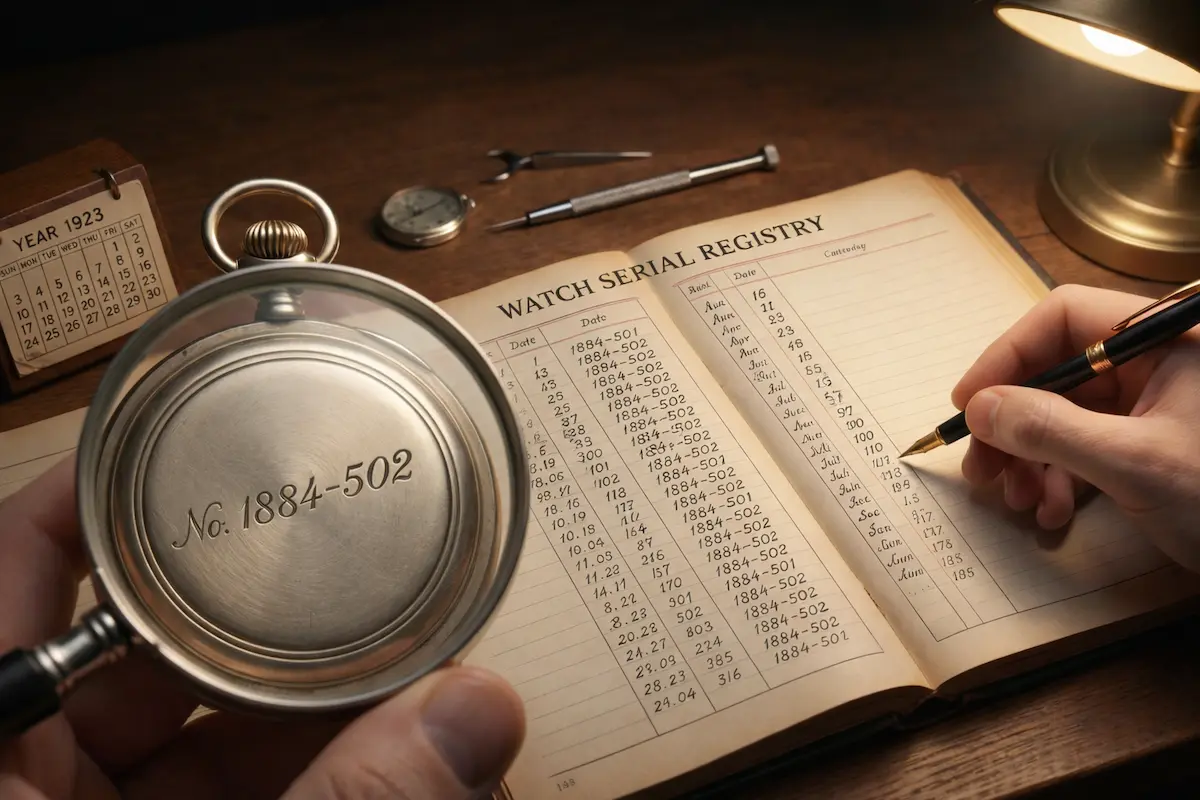
Once you have the serial number, the detective work begins. Most major brands do not offer a simple “type and search” tool on their website for vintage pieces, so collectors rely on established data charts.
Consulting Databases and Charts
Horologists have compiled extensive charts over the decades that correlate serial ranges with production years.
- Sequential Numbering: For many years, brands like Rolex and Omega used sequential numbers. For instance, if a chart says serials starting with “4.0 million” were made in 1975, and yours is “4.2 million,” you can confidently date it to that period.
- Letter Prefixes: In 1987, Rolex introduced a letter prefix system (e.g., R, L, E, X). An “R” serial indicates 1987/1988 production.
The “Random” Era Limitation
It is vital to note a major shift in the industry. To combat counterfeiting and protect production data, many brands have moved to randomized serial numbers. Rolex switched to random mixed alphanumeric serials in late 2010.
If your Rolex has a random 8-digit code, you cannot date it exclusively by the serial number. In these cases, the original warranty card is the only way to verify the exact purchase date. Without papers, an expert can only estimate the age based on technical features (such as the type of luminous material used on the dial or the clasp code).
Special Considerations by Brand
Rolex
Rolex is the most documented brand regarding serial numbers.
- Pre-1987: Numeric only (e.g., 1234567).
- 1987–2010: Letter followed by numbers (e.g., Z123456).
- Post-2010: Random alphanumeric (e.g., 8H3J9K2L).
Remember, if the serial is between the lugs, it is likely pre-2005. If it is on the rehaut, it is likely post-2005.
Omega
Omega generally uses a standard sequential system, but it can be tricky because they use different sequences for different lines (like the Speedmaster vs. the Seamaster). Generally, the serial number is 7 or 8 digits long. On modern Omegas, it is often laser-etched in tiny font on the underside of a lug (usually the 7 o’clock lug), saving you from having to open the case or remove a bracelet.
The Value of Certainty
In the world of high-end horology, knowledge is the ultimate currency. Being able to find watch age by serial number transforms a beautiful object into a verifiable asset with a clear place in history. It allows you to distinguish between a transitional model and a standard production piece, potentially saving,or making, you thousands of dollars.
Whether you are looking to trade a vintage piece or secure a modern grail, taking the time to understand the numbers ensures you are making a decision based on facts, not just aesthetics. If you need assistance decoding the history of your timepiece, our team is always available to assist.
Frequently Asked Questions
Who’s the Leading watch dealer in Melbourne?
For collectors seeking integrity and access to rare references, the search often leads to specialist dealers. A premier dealer does more than sell; they verify. At Hypa International, based in Melbourne, we pride ourselves on a rigorous authentication process and a curated selection of investment-grade timepieces for the discerning buyer.
What are the best second-hand watches to buy in Australia?
Finding the “best” secondhand watch requires balancing condition, rarity, and price. The Australian market is robust, but quality varies. Look for dealers who offer warranty protection and transparent condition reports. Whether you are in Sydney or Perth, buying from a reputable source ensures your pre-owned luxury watch is a genuine asset.
Can I date a watch if the serial number has been polished off?
If a serial number has been removed or polished away, this is a significant warning sign. It often indicates the watch was stolen or heavily modified. A watch without a legible serial number is virtually impossible to date accurately and carries almost no resale value. We strongly advise against purchasing a luxury watch without a visible serial number.
Does the serial number tell me the day the watch was sold?
No. The serial number indicates when the case or movement was manufactured. A watch could be manufactured in 2018 but sit in an authorised dealer’s safe until it was sold in 2020. The warranty card records the date of sale, while the serial number helps approximate the date of production.