The world of luxury watches is built on centuries of innovation, where the movement inside a timepiece is as significant as its design. For collectors, the choice between an automatic and a manual wind watch is a fundamental one, shaping not just how the watch performs but also the owner’s relationship with it. Whether you are acquiring your first significant piece or expanding a curated collection, understanding these two mechanical marvels is essential. At Hypa International, we guide collectors through these decisions, ensuring every choice is made with confidence and clarity.
This guide will walk you through the history, mechanics, and key differences between automatic and manual wind watches. By the end, you’ll have a clear understanding of what powers these incredible machines and be better equipped to decide which type of movement aligns with your lifestyle and collection goals.
The Dawn of Self-Winding: A History of Automatic Watches
The concept of a self-winding watch dates back to the 1770s with Swiss watchmaker Abraham-Louis Perrelet, who developed a movement powered by an oscillating weight. This groundbreaking idea was refined over the next century by horological masters like Abraham-Louis Breguet. However, it wasn’t until the 1920s that the automatic wristwatch began to take shape, thanks to English watch repairer John Harwood. He designed a mass-producible automatic movement using a centrally mounted rotor that swung back and forth.
While Harwood’s innovation was significant, it was Rolex that perfected and popularised the technology. In 1931, Rolex introduced its ‘Perpetual’ movement, featuring a rotor that could spin a full 360 degrees. This mechanism, housed within the iconic water-resistant Oyster case, created the Rolex Oyster Perpetual. This model revolutionised the industry and laid the foundation for the brand’s enduring success, establishing automatic movements as the new standard for convenience and reliability in mechanical watches.
How Automatic Watches Work
An automatic watch is powered by the kinetic energy generated from the natural motion of the wearer’s wrist. This elegant, self-sustaining system is a marvel of micro-engineering.
At its core is a semi-circular metal weight called a rotor. As the wearer moves, the rotor pivots freely, and this rotation winds the mainspring, which is a coiled strip of metal that stores the watch’s energy. From there, the mainspring releases its power in a controlled manner through a series of gears known as the gear train. This energy ultimately reaches the escapement and balance wheel, which work together to regulate the release of energy in precise, consistent intervals. This rhythmic process is what drives the watch’s hands with the smooth, sweeping motion prized by collectors. If worn daily, an automatic watch can run indefinitely without manual winding.
The Art of Interaction: How Manual Wind Watches Work
A manual wind watch, as the name suggests, requires the owner to wind it by hand to generate power. This is done by turning the crown, the small knob on the side of the watch case. Turning the crown tightens the mainspring, storing the energy needed to power the watch. Like an automatic watch, this energy is then transferred through the gear train to the escapement and balance wheel, which regulate its release to keep accurate time.
The power reserve of a manual watch,how long it will run on a full wind,can range from around 40 hours to several days, depending on the movement’s design. For many collectors, the daily ritual of winding their watch is a cherished part of ownership. It creates a tactile connection to the intricate mechanics inside, a moment of appreciation for the craftsmanship that makes it all possible.
Automatic vs. Manual: Key Differences
When choosing between an automatic and a manual watch, several factors come into play. Each offers a distinct experience and set of characteristics that may appeal to different collectors.
- Convenience: Automatic watches are the clear winner here. As long as they are worn regularly, they remain wound, making them ideal for daily wear. Manual watches require winding every day or two, which can be seen as either a charming ritual or a minor inconvenience.
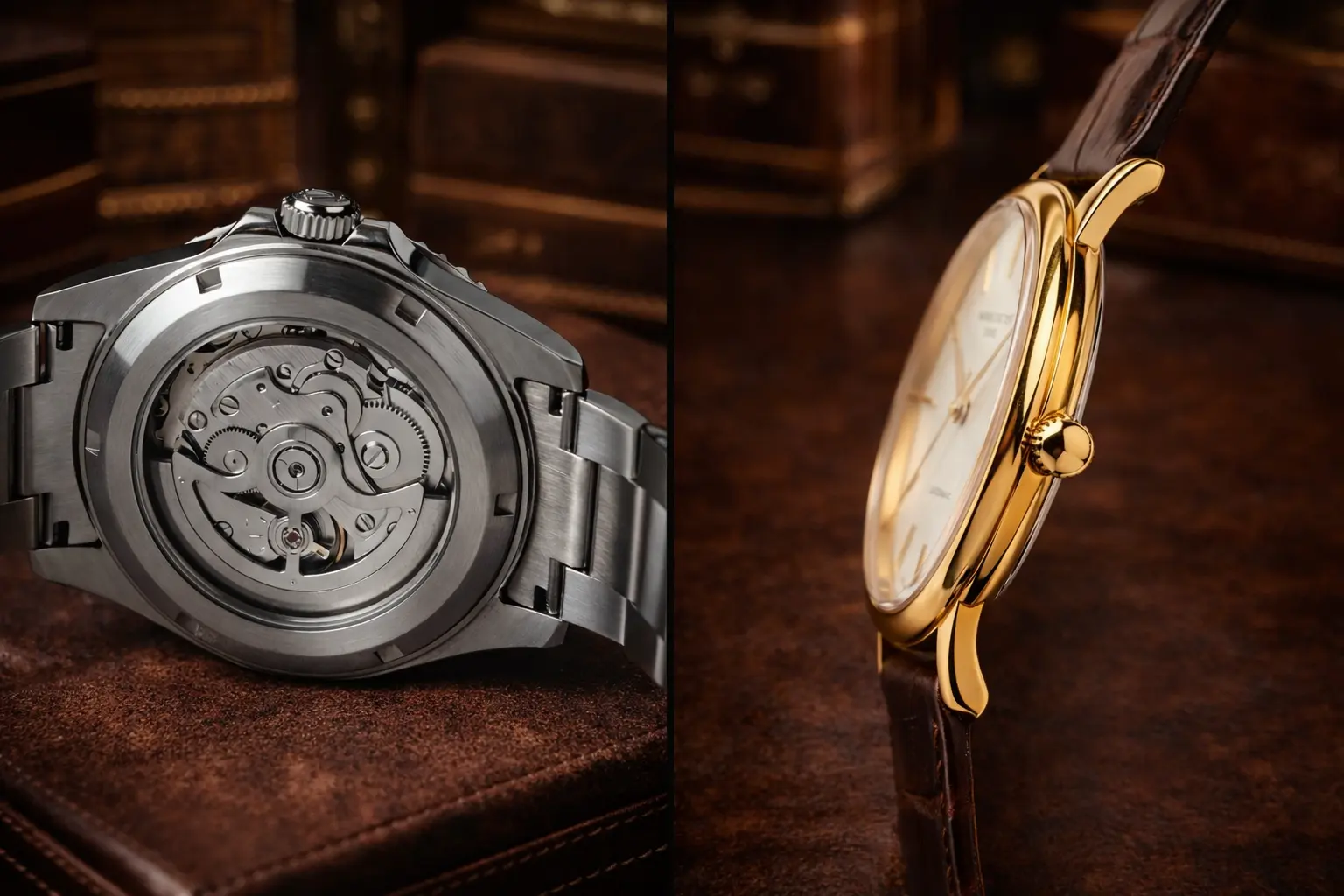
- Case Size and Profile: Automatic movements require a rotor, which adds thickness and weight. Consequently, automatic watches tend to have bulkier cases. Manual watches, without the need for a rotor, can be built with much slimmer and more elegant profiles, allowing them to sit more discreetly on the wrist.
- Aesthetic and Display: Many luxury watches feature an exhibition case back, offering a view of the movement. On an automatic watch, the rotor can obscure parts of the intricate mechanism. A manual watch, by contrast, provides an unobstructed view of the beautifully finished gears, bridges, and balance wheel in action.
- Durability and Complexity: Automatic movements contain more components than manual ones, making them inherently more complex. While modern automatic watches are built to be robust, the additional parts mean there are more potential points of failure over the long term compared to a simpler manual movement.
Servicing and Maintenance
Both automatic and manual mechanical watches are intricate machines that require regular maintenance to ensure their accuracy and longevity. Over time, the lubricants that keep the hundreds of tiny components moving smoothly can dry out, and parts can wear down.
It is generally recommended that a mechanical watch be serviced by a qualified watchmaker every five to seven years. During a service, the watch is completely disassembled, each component is cleaned and inspected, worn parts are replaced, and the movement is reassembled and lubricated. This process ensures the timepiece continues to function correctly and maintains its value for generations. Proper care is an investment in the legacy of your watch.
Luxury Watch Options at Hypa International
At Hypa International, we specialise in sourcing and authenticating the world’s most sought-after timepieces. Whether your preference is for the convenience of an automatic movement or the traditional charm of a manual wind, our collection features exceptional examples of both. We are recognised as a leading luxury watch dealer in Melbourne, offering a curated selection from premier brands. Our expertise and global network allow us to connect collectors with rare and investment-grade watches, ensuring every acquisition is a confident one.
Making the Right Choice for Your Collection
The decision between an automatic and a manual wind watch ultimately comes down to personal preference and how you intend to use your timepiece. An automatic watch offers modern convenience and is perfect for a daily-wear luxury piece that you can set and forget. A manual watch provides a deeper, more intimate connection to the art of watchmaking, appealing to purists and those who appreciate the daily ritual of winding.
Neither is definitively “better” than the other; they simply offer different experiences of ownership. As you consider your next acquisition, think about what you value most in a watch: is it effortless performance, or is it the tactile engagement with a timeless piece of mechanical art?
Frequently Asked Questions
What makes a business a leading watch dealer in Melbourne?
A leading watch dealer in Melbourne, like Hypa International, is distinguished by its proven expertise in authenticating high-value timepieces, a global network for sourcing rare models, and a reputation built on trust and transparency. They provide a secure environment for buying, selling, and trading, offering collectors confidence through rigorous inspection processes and deep market knowledge. This ensures clients receive fair value and access to genuine, investment-grade watches.
What should you look for in the best second hand watches in Melbourne?
When searching for the best second-hand watches in Melbourne, prioritise authenticity, condition, and provenance. A reputable dealer will provide a certificate of authenticity and a detailed condition report. Look for watches with original box and papers, as this significantly adds to their value and confirms their history. A trusted dealer will have a rigorous inspection process and offer a warranty, giving you peace of mind in your investment.
Can I over-wind a manual watch?
Modern manual wind watches are designed with a built-in mechanism that prevents over-winding. As you wind the crown, you will feel increasing resistance. Once the mainspring is fully wound, the crown will stop turning. It is important not to force it beyond this point.
What happens if I don’t wear my automatic watch?
If you don’t wear your automatic watch, it will stop running once its power reserve is depleted. The power reserve is the length of time the watch can run on a full wind, typically ranging from 38 to 72 hours. To get it running again, you can simply wind it manually by turning the crown a few times and then setting the time.
Do automatic watches need batteries?
No, automatic watches do not use batteries. They are fully mechanical and are powered by the energy generated from the motion of your wrist. This self-sustaining system is one of the defining features and appeals of a mechanical timepiece.